Gang violence in Central
America has led to a startling increase in the number of children who
make the dangerous journey across the Mexican border alone in search of
asylum in the United States, according to a report by the Women's
Refugee Commission, a nonprofit that advocates for displaced women and
children.
The number of unaccompanied migrant children in U.S.
detention centers grew nearly 50%, from 6,854 in fiscal 2011 to more
than 10,000 in the nine-month period ended June 30, according to federal
statistics cited in the report, titled "Forced From Home: The Lost Boys
and Girls of Central America." With three months left in the latest
reporting period, the fiscal 2012 figures are expected to rise further.
Most of the growth came from three countries: El Salvador, with 68% more unaccompanied minors; Guatemala, with 72% more; and Honduras,
with the number more than doubling, from 1,201 to 2,477. The number of
Mexican children crossing the border alone fell in the same period.
In interviews conducted with
151 children in federal holding facilities, nearly 80% told researchers
that violence was the main reason they set out for the U.S. by
themselves, traveling with paid guides on buses or chancing the desert
trek as stowaways on top of trains.
One 16-year-old from Honduras
told the report's authors that he was threatened with physical violence
after refusing to be recruited by a gang. He could no longer attend
school safely, so he came to the U.S. to continue his studies.
The
children travel on their own because their parents are already in the
U.S., because they are fleeing domestic violence or because the family
cannot undertake the journey together, said advocates who work with
them.
"What they said is, 'If I stayed, I definitely would die.'
They knew it would be a dangerous journey, but at least there's a
chance," said Michelle Brane, director of the Women's Refugee
Commission's detention and asylum program.
U.S. Customs and Border Protection,
along with the Department of Health and Human Services' Office of
Refugee Resettlement, were criticized in the report for operating
substandard detention facilities. Officials from the two agencies were
unavailable for comment.
The Federation for American Immigration
Reform, an anti-immigration group, blamed the influx of Central American
children on a new federal program granting a two-year reprieve from
deportation to some young immigrants.
"The Obama administration
has made it very clear — if you get your kids to the U.S. and keep them
here for a while, they can stay," said Ira Mehlman, a spokesman for the
group. "That's the unmistakable message he's sent around the world. Not
surprisingly, you have parents who say, 'Let's do that.'"
Other
countries are responsible for ensuring the safety of their own citizens,
Mehlman added. Asylum should be reserved for a select few cases, or
"the potential is you could have billions of people qualifying for
political asylum in the U.S."
Most of the young border-crossers will end up going back to the countries they fled, immigrant advocates said.
The
children have no right to a court-appointed attorney in asylum
proceedings. Even with legal counsel, cases based on the threat of gang
violence have proved difficult to win. Most successful cases have
involved children who have lost their parents because of abandonment,
abuse or neglect, said Judy London, directing attorney of the
Immigrants' Rights Project at the pro bono law firm Public Counsel.
"It's
all dependent on getting an experienced lawyer," London said. "The vast
majority aren't going to get the legal representation they need, or
they're going to get it too late."
Emergency "surge" shelters to house young migrants arriving without parents have been built, said the report.
The
report likened conditions in the surge facilities, opened after October
2011 by the Office of Refugee Resettlement, to those in an emergency
hurricane shelter. The children received basic medical care, four hours
of school and some recreation but not the full slate of education and
case management offered in regular detention centers.
Because the
new centers sprung up so quickly, they often neglected to provide the
"Know Your Rights" legal orientations that are standard in detention
facilities, leaving the children clueless about their options, the
report said.
The massive increase also resulted in detainees
spending longer periods in temporary holding cells, nicknamed "freezers"
operated by Customs and Border Protection. The children described the
cells' conditions to the report's authors as having inadequate food and
water and lights on 24 hours a day, and lacking blankets in frigid
temperatures, showers and enough room to lie down.
http://www.latimes.com/news/local/la-me-immigration-children-20121016,0,6904349.story
Tuesday, October 16, 2012
Family of teen killed in border shooting alleges excessive force, will sue
PHOENIX -- The family of a teenager shot and killed in an incident at the border last week says they will file a lawsuit alleging excessive force.
According to Nogales Mayor Ramon Guzman Munoz, Jose Rodriguez, 16, died in "a hail of bullets." He said the teen was hit seven times. Another Mexican official said Rodriguez, pictured above in a photo taken several years ago, was shot in the back.
It happened Wednesday after the Border Patrol received reports of suspected drug smugglers. Agents reportedly saw two people abandon a load of drugs and dart back across the border into Mexico.
Those people then began throwing rocks at the agents, ignoring orders to stop.
That's when an agent opened fire.
Police found Rodriguez' body on a sidewalk near the border barrier.
While a Mexican official told The Associated Press the teen was shot by the Border Patrol agent, the Border Patrol has said only that shots were fired that night. The agency has not identified the agent who fired and is not commenting pending the outcome of the investigation.
Rodriguez' family has not said exactly when they will file suit.
Border agents are generally allowed to use lethal force against rock throwers, and there are several ongoing investigations into similar shootings in Arizona and Texas.
http://www.azfamily.com/news/Family-of-teen-killed-in-border-shooting-alleges-excessive-force-174375151.html
U.S. Border Patrol Fires at Rock Throwers in Mexico, and Three Have Died
Shortly before midnight on
Wednesday, a stocky 16-year-old Mexican boy died face down on a pitted
concrete sidewalk in Nogales, Sonora, Mexico. José Antonio Elena Rodriguez
had been shot seven times. His alleged killer, a U.S. Border Patrol
agent, had gunned him down from the Arizona side of the border.
The
Border Patrol, in a statement to The Daily Beast, claims the FBI is
investigating the shooting, which began when Border Patrol agents came
upon smugglers dropping loads of narcotics in Nogales, Ariz. As the
smugglers hightailed it back into Mexico, the agents were “assaulted”
with rocks from the Mexican side, the statement says. The agents ordered
the rock throwers to “cease.” When the rocks kept coming in from
Mexico, an agent “discharged his service weapon.” The Border Patrol did
not say an agent killed the boy, but said instead “one of the subjects
appeared to have been hit.”
The
unlikely scenario of Border Patrol agents in the United States gunning
down Mexican rock throwers in Mexico has played out several times in the
last two years, outraging the Mexican government, raising questions
about the Border Patrol’s use of force, and causing diplomatic huddles
between the two countries.
“This
is happening with a disturbing frequency,” a high-placed Mexican
official who is very familiar with the Rodriguez shooting investigation
tells The Daily Beast. “It’s about use of force. How much of a threat
is a rock compared to a firearm?”
Not
counting the Rodriguez case, in the last two years, Border Patrol
agents in the United States have reportedly shot and killed at least
three Mexicans in Mexico, and injured at least one other, according to
press reports. In each case, rocks were allegedly thrown from Mexico
into the United States either as a way to divert agents from arresting
Mexicans or as a mean-spirited taunt.
At
least one other killing may have occurred in Nogales, Sonora, Mexico.
On Jan. 5, 2011, a Border Patrol agent shot and killed 17-year-old
Ramses Barron Torres when he and others on the Mexican side of the fence
allegedly began throwing rocks at Border Patrol agents making a drug
bust in the United States, according to Nogales International newspaper.
A
year before, a Mexican teen was shot and killed by a Border Patrol
agent on the Mexican side of the Rio Grande in Juarez, Chihuahua,
Mexico. The agent claimed the boys were running into the United States,
then running back into Mexico. When he grabbed one of the boys, the
agent said, the others began throwing rocks at him. He fired. The family
filed a wrongful-death lawsuit against the agent in the United States,
but it was dismissed, according to the El Paso Times, because the shooting occurred in Mexico.

Another fatal shooting
occurred in September. A Mexican man on the Mexico side of the Rio
Grande near Nuevo Laredo was shot by a Border Patrol agent aboard a boat
in U.S. waters, according to the San Antonio Express-News. The family said the man was picnicking; the Border Patrol said the victim was pelting the agent with rocks.
The
Mexican official familiar with all the investigations tells The Daily
Beast that in addition to the shootings in Mexico, in the last six
years, more than two dozen Mexicans have been “shot, Tazered, or
otherwise abused” by Border Patrol agents and other law enforcement
officials on the American side of the border. Very often, rock throwing
is part of the scenario. Since the shootings are found to be justifiable
by U.S. officials, the message to Border Patrol agents is, “it’s fair
game for a Border Patrol agent to shoot a Mexican,” he says.
“What
would happen,” the official asks, “if the tables were turned? What
would happen if an American teenager threw rocks at a Mexican agent and
the Mexican agent shot the American? This is the question we always ask
Americans.”
Mexican leaders met Friday in Mexico City to discuss the Rodriguez killing, according to The Arizona Republic, and the shooting has been roundly condemned by all levels of Mexican government.
In Washington on Thursday, the Mexican Embassy issued a blistering
statement saying preliminary information about the Rodriguez shooting
raises “serious doubts about the use of lethal force by U.S. Border
Patrol agents, something that both the Mexican Government and Mexican
society strongly deplore and condemn.”
The
shootings have sparked “conversations” between the United States and
Mexico, says Christopher Wilson, an expert on Border Patrol issues and
associate in the Mexico Institute Woodrow Wilson Center in Washington.
No one wants to deprive the Border Patrol of the use of weapons to deter
and defend, says Wilson. But the shootings “have happened several
times” and bear similarities—young victims, rock throwing, and a debate
over whether the victims were really rock throwers, narco-traffickers,
or innocent bystanders.
‘What would happen if an American teenager threw rocks at a Mexican agent and the Mexican agent shot the American? This is the question we always ask Americans.’
“There’s
a lot of space for conversations on creative ways” for the United
States to manage Border Patrol “protocols,” Wilson says, so such
incidents don’t occur in the future.
At
least one method—shooting things other than bullets—seems to work. Last
year, a Nogales-based Border Patrol agent “used a pepper ball launcher
to repel a rock-throwing smuggling suspect and seize $12,500 worth of
marijuana,” the Nogales International reported.
No one was injured.
http://www.thedailybeast.com/articles/2012/10/13/u-s-border-patrol-fires-at-rock-throwers-in-mexico-and-three-have-died.html
http://www.thedailybeast.com/articles/2012/10/13/u-s-border-patrol-fires-at-rock-throwers-in-mexico-and-three-have-died.html
Wednesday, August 29, 2012
Monday, August 27, 2012
Border deaths at historic highs even as crossings plunge
Historically low numbers of people are crossing the border illegally
into Southern Arizona this year, but they're still dying at historically
high rates.
In the 10 months through July 31, remains of 161 suspected illegal immigrants have been found in Southern Arizona from New Mexico to the Yuma County line.
That puts this year's death toll on pace to end up at about the annual average for the last decade - 197 - even though that period includes years when there were three to four times as many attempted crossings.
That means the rate of border deaths so far this year - the number of deaths per 100,000 apprehensions - is at about the record high set last year, 154. Illegally crossing the border into Arizona is riskier than it's ever been.
Experts point to a few factors keeping the death rate up.
With the border harder to cross, "smugglers will guide illegal aliens through more remote, harsh terrain to avoid detection by law enforcement, which increases risk of death," U.S. Border Patrol spokesman Brent Cagen said in a written response to questions.
Another possible factor: Central Americans seem to be a growing proportion of those crossing the border illegally. They may arrive at the U.S. border already in greater distress than Mexicans who are just leaving their home country, said Geoff Boyce, spokesman for No More Deaths, a group that patrols areas southwest of Tucson to help migrants.
Also, not every set of remains may be from a recently deceased person.
Joe Adams and his crew have found at least two sets of remains in the last couple of months. Adams, a St. Louis private investigator who leads a border-watch team in the area south of Three Points, reported a woman's decomposing body in early May.
Mariana Chaverri Piña had died in the previous few days. But they also found the bones of at least one person in July, and it was unclear how long that body had been there.
"In 2011, nearly half of all discoveries of deceased individuals were those of skeletal remains," wrote Cagen of the Border Patrol.
frantic phone call
Just last week, a family in Waukegan, Ill., was urgently calling authorities in Arizona, begging them to search for their lost loved one. It's a phenomenon that happens here all summer as the heat takes crossers down.
Jaime Pasillas, 42, a father of four American-citizen children, had returned to Mexico earlier this summer to renew a 10-year visa, his family said through announcements from the League of United Latin American Citizens. But his renewal was rejected, and he decided to return illegally.
On July 30, Pasillas called his family to tell them he was crossing from Sonora into Arizona with a "coyote," or smuggler, and would arrive in three to five days, but then they heard nothing. On Aug. 9, family members spoke with the last person known to have seen Pasillas alive.
The picture he painted was painful: Pasillas' feet were wounded in the crossing, and he was lagging behind the group. On Aug. 6, the guides left Pasillas in the desert around Santa Rosa in the northern Tohono O'odham Nation, with a gallon of water. The high temperature that day in Ajo and Tucson was 106 degrees.
Family members came to Southern Arizona to try to help find him, and Julie Contreras of LULAC urged tribal authorities and the Border Patrol to search. The patrol did prepare to launch a search early Aug. 13, but then they found out the O'odham police had found a body three days before.
While final identification has not occurred, the family has identified Pasillas by a tattoo. Now they are working to get his body returned to Waukegan.
At border, in distress
Some crossers are arriving at the border already in medical distress.
Tucson-based Humane Borders is setting up water stations in Mexico, in cooperation with Mexican authorities, because some migrants have walked so far before even crossing the border into the U.S.
"Many people that are trying to cross are going to points extremely far east or west of the main crossing areas while still on Mexican soil," said Bob Feinman, a board member of Humane Borders. "By foot these can be a couple or three days."
Indeed, agents in the Border Patrol's Tucson Sector are on pace to carry out about 13 percent more rescues this year than last, when they recorded 500.
No More Deaths members, who work in the broad area around Arivaca, have seen the same trend, Boyce said. Migrants walk west from Nogales for a day or two to get into the better-hidden canyons and washes before cutting north into the United States.
"By the time people get to where we're going to see them in our work," he said, "it adds that much more strain and environmental exposure."
Rate of death rises
The number of people trying to cross the border into Southern Arizona illegally has been plummeting, but the number of people dying in the process is not. The reason: It's more risky to cross. This chart shows the number of bodies found in the Tucson Sector per 100,000 Border Patrol apprehensions. While apprehensions aren't a direct measure of crossings, other measures have also shown migration is extremely low.
Year Number of deaths per 100,000 apprehensions
2004 39
2005 52
2006 46
2007 59
2008 57
2009 88
2010 119
2011 154
2012* 153
* Through July 31
http://azstarnet.com/news/local/border/border-deaths-at-historic-highs-even-as-crossings-plunge/article_90dd06a4-63cd-5ca2-b40a-f499909bf7ae.html
In the 10 months through July 31, remains of 161 suspected illegal immigrants have been found in Southern Arizona from New Mexico to the Yuma County line.
That puts this year's death toll on pace to end up at about the annual average for the last decade - 197 - even though that period includes years when there were three to four times as many attempted crossings.
That means the rate of border deaths so far this year - the number of deaths per 100,000 apprehensions - is at about the record high set last year, 154. Illegally crossing the border into Arizona is riskier than it's ever been.
Experts point to a few factors keeping the death rate up.
With the border harder to cross, "smugglers will guide illegal aliens through more remote, harsh terrain to avoid detection by law enforcement, which increases risk of death," U.S. Border Patrol spokesman Brent Cagen said in a written response to questions.
Another possible factor: Central Americans seem to be a growing proportion of those crossing the border illegally. They may arrive at the U.S. border already in greater distress than Mexicans who are just leaving their home country, said Geoff Boyce, spokesman for No More Deaths, a group that patrols areas southwest of Tucson to help migrants.
Also, not every set of remains may be from a recently deceased person.
Joe Adams and his crew have found at least two sets of remains in the last couple of months. Adams, a St. Louis private investigator who leads a border-watch team in the area south of Three Points, reported a woman's decomposing body in early May.
Mariana Chaverri Piña had died in the previous few days. But they also found the bones of at least one person in July, and it was unclear how long that body had been there.
"In 2011, nearly half of all discoveries of deceased individuals were those of skeletal remains," wrote Cagen of the Border Patrol.
frantic phone call
Just last week, a family in Waukegan, Ill., was urgently calling authorities in Arizona, begging them to search for their lost loved one. It's a phenomenon that happens here all summer as the heat takes crossers down.
Jaime Pasillas, 42, a father of four American-citizen children, had returned to Mexico earlier this summer to renew a 10-year visa, his family said through announcements from the League of United Latin American Citizens. But his renewal was rejected, and he decided to return illegally.
On July 30, Pasillas called his family to tell them he was crossing from Sonora into Arizona with a "coyote," or smuggler, and would arrive in three to five days, but then they heard nothing. On Aug. 9, family members spoke with the last person known to have seen Pasillas alive.
The picture he painted was painful: Pasillas' feet were wounded in the crossing, and he was lagging behind the group. On Aug. 6, the guides left Pasillas in the desert around Santa Rosa in the northern Tohono O'odham Nation, with a gallon of water. The high temperature that day in Ajo and Tucson was 106 degrees.
Family members came to Southern Arizona to try to help find him, and Julie Contreras of LULAC urged tribal authorities and the Border Patrol to search. The patrol did prepare to launch a search early Aug. 13, but then they found out the O'odham police had found a body three days before.
While final identification has not occurred, the family has identified Pasillas by a tattoo. Now they are working to get his body returned to Waukegan.
At border, in distress
Some crossers are arriving at the border already in medical distress.
Tucson-based Humane Borders is setting up water stations in Mexico, in cooperation with Mexican authorities, because some migrants have walked so far before even crossing the border into the U.S.
"Many people that are trying to cross are going to points extremely far east or west of the main crossing areas while still on Mexican soil," said Bob Feinman, a board member of Humane Borders. "By foot these can be a couple or three days."
Indeed, agents in the Border Patrol's Tucson Sector are on pace to carry out about 13 percent more rescues this year than last, when they recorded 500.
No More Deaths members, who work in the broad area around Arivaca, have seen the same trend, Boyce said. Migrants walk west from Nogales for a day or two to get into the better-hidden canyons and washes before cutting north into the United States.
"By the time people get to where we're going to see them in our work," he said, "it adds that much more strain and environmental exposure."
Rate of death rises
The number of people trying to cross the border into Southern Arizona illegally has been plummeting, but the number of people dying in the process is not. The reason: It's more risky to cross. This chart shows the number of bodies found in the Tucson Sector per 100,000 Border Patrol apprehensions. While apprehensions aren't a direct measure of crossings, other measures have also shown migration is extremely low.
Year Number of deaths per 100,000 apprehensions
2004 39
2005 52
2006 46
2007 59
2008 57
2009 88
2010 119
2011 154
2012* 153
* Through July 31
http://azstarnet.com/news/local/border/border-deaths-at-historic-highs-even-as-crossings-plunge/article_90dd06a4-63cd-5ca2-b40a-f499909bf7ae.html
Tuesday, November 22, 2011
Aerial Sheriff
From BLDGBLOG
 [Image: A U.S. Predator drone, photographed by Lt. Col. Leslie Pratt, courtesy of the U.S. Air Force via Wikipedia].
The Send Equipment for National Defense Act, sponsored by Texas Representative Ted Poe, would "require that 10 percent of certain equipment returned from Iraq—like Humvees, night-vision equipment and unmanned aerial surveillance craft—be made available to state and local agencies for border-security operations."
Poe denies that this would militarize the border, as reported by the New York Times; but John Cook, mayor of the border city of El Paso, strongly disagrees, suggesting that only "a whole lot of ignorance" could inspire the plan. Cook points out that "moving war zone equipment to the border would send the wrong signal to Mexico and potentially damage the robust symbiotic economic relationship between the two countries."
This comes at the same time that Miller-McCune warns that "armed police drones"—or weaponized UAVs—might soon be flying through a sky near you. While Miller-McCune focuses specifically on the sheriff of Montgomery County, Texas, it's worth pointing out that so-called Leptron Avengers—"battery-operated helicopters designed to take high-resolution video and photos and that can be equipped with night-vision cameras or thermal-imaging equipment"—have also been requested by the Texas city of Arlington, perhaps making Texas—alongside such places as Syria, North Korea, and China—the go-to site today for witnessing civilian adaptations of military surveillance technology.
 [Image: The ShadowHawk unmanned police helicopter by Vanguard Defense Industries, via Miller-McCune].
The current version of this equipment, called the ShadowHawk, "won’t carry weapons," we're told, but "the drone’s manufacturer, Vanguard Defense Industries, boasts that it’s strong enough to carry a shotgun or even a grenade launcher." The firm itself adds that the "ShadowHawk can maintain aerial surveillance of an area (i.e. house, vehicle, person, etc.) at 700 feet without being heard or seen unlike full sized aircraft. Imagine the advantage provided to an entry team in the following scenarios: high risk warrant, hostage rescue, domestic violence, etc."
Mechanized urban surveillance is hardly news. Indeed, the currently existing network of CCTV cameras already installed in cities all over the world is equally "unmanned," in an exactly comparable sense; they are fixed-point drones. One could thus make an argument that the ShadowHawk is simply a camera with wings: you have a camera outside CVS or Tesco, ergo you have a camera in the sky above the city. It's easy to see how "mission creep," as Miller-McCune calls it, could occur.
Or compare this, for instance, to plans aflight in the UK, where police "are planning to use unmanned spy drones, controversially deployed in Afghanistan, for the 'routine' monitoring of antisocial motorists, protesters, agricultural thieves and fly-tippers, in a significant expansion of covert state surveillance." This will take the form of unmanned airships hovering over the English capital, as if simulating the barrage balloons of World War II.
 [Image: Barrage balloons above London, courtesy of Wikipedia].
The drones "are programmed to take off and land on their own, stay airborne for up to 15 hours and reach heights of 20,000ft, making them invisible from the ground," and they will be launched "in time for the 2012 Olympics." (An Afghanistan-based version of this program is described as follows: "This fall, there’ll be a new supercomputer in Afghanistan. It’ll be floating 20,000 feet above the warzone, aboard a giant spy blimp that watches and listens to everything for miles around.")

 [Images: From an October 2009 presentation by Major General Blair Hansen to the U.S. Strategic Command and Defense Intelligence Agency].
Briefly, I'm reminded of the opening scene from Christopher Dickey's book Securing the City, in which a helicopter that falls somewhere between aerial war machine and advanced Hollywood film equipment is breathlessly unveiled: "The winter air is cold and the light hard-edged as the unmarked New York City Police Department helicopter meanders through the winds above the five boroughs," we read.
In any case, the ShadowHawk, described above, can also be put to use in fire and rescue situations, able to track down "heat sources and cut through the smoke and haze with it’s Forward Looking Infrared (FLIR) or SWIR"—short wave infrared—cameras. Indeed, the company points out that "the vast capabilities of the ShadowHawk are ideal for mitigating and handling disasters whether natural or manmade. From locating victims, serving as an airborne communications relay point or conducting damage assessment, the ShadowHawk will significantly expand response capabilities." In light of this, it is foolish to reject, universally and in principle, the very idea of unmanned systems operating in non-military environments; but it's equally foolish to welcome them without a simultaneous demand for strong regulation and oversight.
To be honest, though, it seems only a matter of time before armed police drones are a reality in the United States, and it would thus be great to see a long discussion of the legality—or, at the very least, the societal implications—of such equipment, before we are faced with a scenario none of us adequately understand. For instance, is there a law course somewhere examining the rights and implications of autonomous urban police technologies? Combine this with a look at repurposed military hardware used in patrolling national borders, and the syllabus from such a course would be well worth exploring in detail.
(In addition to the London example, cited above, another rebuke to the moral self-congratulation of the Miller-McCune piece comes from Northern Ireland, where the use of unmanned aerial systems in urban policing might soon take the form of "mini drones" used "to combat crime and the dissident republican threat"—in other words, autonomous police drones are by no means limited to cities in the United States).
[Image: A U.S. Predator drone, photographed by Lt. Col. Leslie Pratt, courtesy of the U.S. Air Force via Wikipedia].The Send Equipment for National Defense Act, sponsored by Texas Representative Ted Poe, would "require that 10 percent of certain equipment returned from Iraq—like Humvees, night-vision equipment and unmanned aerial surveillance craft—be made available to state and local agencies for border-security operations."
Poe denies that this would militarize the border, as reported by the New York Times; but John Cook, mayor of the border city of El Paso, strongly disagrees, suggesting that only "a whole lot of ignorance" could inspire the plan. Cook points out that "moving war zone equipment to the border would send the wrong signal to Mexico and potentially damage the robust symbiotic economic relationship between the two countries."
This comes at the same time that Miller-McCune warns that "armed police drones"—or weaponized UAVs—might soon be flying through a sky near you. While Miller-McCune focuses specifically on the sheriff of Montgomery County, Texas, it's worth pointing out that so-called Leptron Avengers—"battery-operated helicopters designed to take high-resolution video and photos and that can be equipped with night-vision cameras or thermal-imaging equipment"—have also been requested by the Texas city of Arlington, perhaps making Texas—alongside such places as Syria, North Korea, and China—the go-to site today for witnessing civilian adaptations of military surveillance technology.
[Image: The ShadowHawk unmanned police helicopter by Vanguard Defense Industries, via Miller-McCune].The current version of this equipment, called the ShadowHawk, "won’t carry weapons," we're told, but "the drone’s manufacturer, Vanguard Defense Industries, boasts that it’s strong enough to carry a shotgun or even a grenade launcher." The firm itself adds that the "ShadowHawk can maintain aerial surveillance of an area (i.e. house, vehicle, person, etc.) at 700 feet without being heard or seen unlike full sized aircraft. Imagine the advantage provided to an entry team in the following scenarios: high risk warrant, hostage rescue, domestic violence, etc."
Mechanized urban surveillance is hardly news. Indeed, the currently existing network of CCTV cameras already installed in cities all over the world is equally "unmanned," in an exactly comparable sense; they are fixed-point drones. One could thus make an argument that the ShadowHawk is simply a camera with wings: you have a camera outside CVS or Tesco, ergo you have a camera in the sky above the city. It's easy to see how "mission creep," as Miller-McCune calls it, could occur.
Or compare this, for instance, to plans aflight in the UK, where police "are planning to use unmanned spy drones, controversially deployed in Afghanistan, for the 'routine' monitoring of antisocial motorists, protesters, agricultural thieves and fly-tippers, in a significant expansion of covert state surveillance." This will take the form of unmanned airships hovering over the English capital, as if simulating the barrage balloons of World War II.
[Image: Barrage balloons above London, courtesy of Wikipedia].The drones "are programmed to take off and land on their own, stay airborne for up to 15 hours and reach heights of 20,000ft, making them invisible from the ground," and they will be launched "in time for the 2012 Olympics." (An Afghanistan-based version of this program is described as follows: "This fall, there’ll be a new supercomputer in Afghanistan. It’ll be floating 20,000 feet above the warzone, aboard a giant spy blimp that watches and listens to everything for miles around.")
[Images: From an October 2009 presentation by Major General Blair Hansen to the U.S. Strategic Command and Defense Intelligence Agency].Briefly, I'm reminded of the opening scene from Christopher Dickey's book Securing the City, in which a helicopter that falls somewhere between aerial war machine and advanced Hollywood film equipment is breathlessly unveiled: "The winter air is cold and the light hard-edged as the unmarked New York City Police Department helicopter meanders through the winds above the five boroughs," we read.
It is a state-of-the-art crime-fighting, terror-busting, order-keeping techno toy, with its enormous lens that can magnify any scene on the streets almost one thousand times, then double that digitally; that can watch a crime in progress from miles away, can look in windows, can sense the body heat of people on rooftops or running along sidewalks, can track beepers slipped under cars, can do so very many things that the man in the helmet watching the screens and moving the images with the joystick in his lap, NYPD Detective David Zschau, is often a little bit at a loss for words. "It really is an amazing tool," he keeps saying.This technology—whose unlimited vision seems so mind-boggling as to cause aphasia in those who encounter it—should inspire as much moral and political discomfort as an unmanned version of the same helicopter; in other words, we shouldn't lose sight of the fact that this very kind of spy equipment already exists and has already been deployed. That is, the unnerving implication that we are being watched from above by undetectable robots should not let us forget that being watched from above by human pilots is just as invasive.
In any case, the ShadowHawk, described above, can also be put to use in fire and rescue situations, able to track down "heat sources and cut through the smoke and haze with it’s Forward Looking Infrared (FLIR) or SWIR"—short wave infrared—cameras. Indeed, the company points out that "the vast capabilities of the ShadowHawk are ideal for mitigating and handling disasters whether natural or manmade. From locating victims, serving as an airborne communications relay point or conducting damage assessment, the ShadowHawk will significantly expand response capabilities." In light of this, it is foolish to reject, universally and in principle, the very idea of unmanned systems operating in non-military environments; but it's equally foolish to welcome them without a simultaneous demand for strong regulation and oversight.
To be honest, though, it seems only a matter of time before armed police drones are a reality in the United States, and it would thus be great to see a long discussion of the legality—or, at the very least, the societal implications—of such equipment, before we are faced with a scenario none of us adequately understand. For instance, is there a law course somewhere examining the rights and implications of autonomous urban police technologies? Combine this with a look at repurposed military hardware used in patrolling national borders, and the syllabus from such a course would be well worth exploring in detail.
(In addition to the London example, cited above, another rebuke to the moral self-congratulation of the Miller-McCune piece comes from Northern Ireland, where the use of unmanned aerial systems in urban policing might soon take the form of "mini drones" used "to combat crime and the dissident republican threat"—in other words, autonomous police drones are by no means limited to cities in the United States).
Monday, November 21, 2011
Call for Indigenous Convergence to Resist ALEC!
Call for Indigenous Convergence to Resist ALEC! – November 29-December 3 – Onk Akimel O’odham Lands (Scottsdale, AZ)
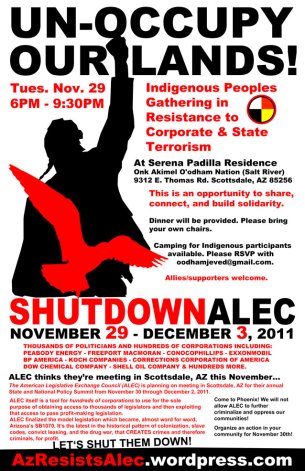 Un-occupy Our Lands!
Indigenous Peoples Gathering in Resistance to Corporate & State Terrorism
Tues. Nov. 29, 6PM – 9:30PM
At Serena Padilla Residence
Onk Akimel O’odham Nation (Salt River)
9312 E. Thomas Rd. Scottsdale, AZ 85256
This is an opportunity to share, connect, and build solidarity.
Dinner will be provided. Please bring your own chairs.
Camping for Indigenous participants available.
Please RSVP with oodhamjeved@gmail.com.
Allies and supporters welcome.
Greetings.
My name is Serena Padilla. I live in Occupied Onk Akimel Jeved, now known as the Salt River Pima Maricopa Indian Community.
I am in support of an Indigenous convergence before and during the American Legislative Exchange Council (ALEC) conference, scheduled for November 30-December 2, in hopes to share, connect and build solidarity amongst all the Indigenous Nations that are affected by ALEC.
At this time, I am opening my grounds to accommodate all Indigenous participants coming to our territory due to the ALEC Conference. I am opening my grounds for camping and access to my outside kitchen.
I hope this gathering will strengthen our connections as Indigenous Peoples, now and for the future generations to come.
More information: www.azresistsalec.wordpress.com
Energy/Mining Companies & ALEC: http://azresistsalec.wordpress.com/2011/10/26/energymining-companies-and-alec/
 Un-occupy Our Lands!
Indigenous Peoples Gathering in Resistance to Corporate & State Terrorism
Tues. Nov. 29, 6PM – 9:30PM
At Serena Padilla Residence
Onk Akimel O’odham Nation (Salt River)
9312 E. Thomas Rd. Scottsdale, AZ 85256
This is an opportunity to share, connect, and build solidarity.
Dinner will be provided. Please bring your own chairs.
Camping for Indigenous participants available.
Please RSVP with oodhamjeved@gmail.com.
Allies and supporters welcome.
Greetings.
My name is Serena Padilla. I live in Occupied Onk Akimel Jeved, now known as the Salt River Pima Maricopa Indian Community.
I am in support of an Indigenous convergence before and during the American Legislative Exchange Council (ALEC) conference, scheduled for November 30-December 2, in hopes to share, connect and build solidarity amongst all the Indigenous Nations that are affected by ALEC.
At this time, I am opening my grounds to accommodate all Indigenous participants coming to our territory due to the ALEC Conference. I am opening my grounds for camping and access to my outside kitchen.
I hope this gathering will strengthen our connections as Indigenous Peoples, now and for the future generations to come.
More information: www.azresistsalec.wordpress.com
Energy/Mining Companies & ALEC: http://azresistsalec.wordpress.com/2011/10/26/energymining-companies-and-alec/
Wednesday, November 2, 2011
Deputies arrest 10 in employer-sanctions raid on Phoenix company
 PHOENIX -- Maricopa County Sheriff Joe Arpaio and his deputies arrested 10 people during an employer-sanctions raid at Prisma Graphic in South Phoenix Tuesday morning.
Deputies converged on the business at 29th Street and Broadway Road at about 7 a.m.
Prisma Graphic employs more than 130 people, according to information on its website. Deputies were looking for 17 people. Ten were arrested -- six during the raid, four later. According to the company president, Simon Beltran, the remaining people have not worked there for about a year.
Beltran said he and his early team leaders were stunned to find deputies surrounding the company's two buildings when they arrived at work, but did everything they could to cooperate.
MCSO reportedly received two separate tips that some of the company's employees are undocumented immigrants who used false or stolen identification to get their jobs. One of those tips specifically mentioned an employee using the Social Security Number of a 14-year-old girl.
According to information provided by one of the tipsters, some of those employees were seen printing out Wells Fargo credit-card information, government hunting tags and Health Net information. MCSO investigators did not find any evidence during the during the operation at Prisma Graphic to corroborate that.
The sheriff said his deputies had developed information about 17 specific people before they ever step foot inside Prisma Graphic.
"We don't racial profile," Arpaio said. "We already know when we come in here who we're going to arrest."
According to MCSO, two of the suspects tried to run but were caught by deputies stationed at the back door.
Arpaio said investigators will keep looking for those other suspects who are no longer employed by Prisma Graphic. He said it's only a matter of time before deputies track them down and take them into custody.
Prisma Graphic CEO Robert Anderson said Wednesday that the six people who were detained on company property were hired prior to 2008, which is when the Legal Arizona Workers Act went into effect, requiring employers to participate in E-Verify. Under the Legal Arizona Workers Act, employers did not have to use E-Verify to substantiate the legal status of people who were already on the payroll.
According to Anderson, the company did its best to verify the immigration status of new employees at the time, requiring them to fill out an employment application, Form I-9 (Employee Eligibility Verification) and provide proper documentation.
Arpaio and his deputies have conducted 54 similar raids in the past few years, the most recent being at C&M Homes, a Mesa construction company, in early October.
"They don't seem to care, these businesses that keep hiring illegal aliens with false ID," Arpaio said at the time. I'm going to keep cracking down. ... I think they should do more, be more vigilant."
Identity theft is a Class 4 felony.
Prisma Graphic opened as a boutique printing shop in Phoenix more than 30 years ago. According to the company's website, the privately-held business had just 30 employees and $1 million in sales in 2000. It has since grown and is now headquartered in an 82,000-square-foot facility, has more than quadrupled its staff and posts $24 million in annual sales.
http://www.azfamily.com/news/Deputies-raid-Phoenix-business-allegedly-employing-undocumented-immigrants-133002043.html
Sunday, August 14, 2011
ALEC thinks they're meeting in Scottsdale, AZ this November...
ALEC thinks they're meeting in Scottsdale, AZ this November...
The American Legislative Exchange Council (ALEC) is a massive non-profit body that brings corporations and legislators together to draft "model" legislation. For example, AZ Senator Russell Pearce and Corrections Corporation of America (CCA), the nation's largest private prison firm, have been members for years. ALEC finalized the model legislation which became, almost word for word, Arizona's SB1070, aka "Support Our Law Enforcement." It's the latest in the historical pattern of colonization, slave codes, convict leasing, and the drug war, that CREATES crimes and therefore criminals, for profit.
With British Petroleum (BP) and the Koch brothers as some of their funders, ALEC has pushed for Three Strikes and Mandatory Minimum sentencing, as well as the Animal Enterprise Terrorism Act. More than 200 of ALEC's model bills became actual laws throughout the country over the past year.
We're a group of people in occupied Indigenous lands, now called Arizona, who demand the end of SB1070 and 287g, the criminalization—and then the incarceration—of migrants, and the militarization of the border. We oppose private prisons, detention centers, and security companies, not simply because they are private, but because we are sickened by profiteering on human misery. ALEC desires "free markets" and "limited government," which means they use the state to support profit-making, the continuance of colonization, and neo-liberal policies (NAFTA, CANAMEX, etc.) that draw lines, make laws, and build freeways and prisons to exploit labor and the earth.
Whether maintained by the state or corporations, we're against all systems of control. We are for freedom of movement for all people.
ALEC should know there are a million better things to do with their time than plotting mass incarceration. But there’s nowhere we’d rather be than confronting their meeting. We're calling for four days of action here in occupied Onk Akimel O’odham lands from November 29th - December 3rd, 2011, with an emphasis for action on November 30th (N30!). We encourage a creative diversity of tactics on N30, the 12th anniversary of the Seattle uprising against the WTO. No matter the acronym, ALEC is no different than all the other gangs of businessmen, politicians, and bureaucrats that we’ve been resisting for over 500 years.
In solidarity with everyone locked up and locked down in AZ, and all O’odham, Yaqui, Lipan Apache separated by the border, and anyone dispossessed by the wealthy and powerful…
Project Baldwin
projectbaldwin@riseup.net
see also: azresistsalec.wordpress.com
The American Legislative Exchange Council (ALEC) is a massive non-profit body that brings corporations and legislators together to draft "model" legislation. For example, AZ Senator Russell Pearce and Corrections Corporation of America (CCA), the nation's largest private prison firm, have been members for years. ALEC finalized the model legislation which became, almost word for word, Arizona's SB1070, aka "Support Our Law Enforcement." It's the latest in the historical pattern of colonization, slave codes, convict leasing, and the drug war, that CREATES crimes and therefore criminals, for profit.
With British Petroleum (BP) and the Koch brothers as some of their funders, ALEC has pushed for Three Strikes and Mandatory Minimum sentencing, as well as the Animal Enterprise Terrorism Act. More than 200 of ALEC's model bills became actual laws throughout the country over the past year.
We're a group of people in occupied Indigenous lands, now called Arizona, who demand the end of SB1070 and 287g, the criminalization—and then the incarceration—of migrants, and the militarization of the border. We oppose private prisons, detention centers, and security companies, not simply because they are private, but because we are sickened by profiteering on human misery. ALEC desires "free markets" and "limited government," which means they use the state to support profit-making, the continuance of colonization, and neo-liberal policies (NAFTA, CANAMEX, etc.) that draw lines, make laws, and build freeways and prisons to exploit labor and the earth.
Whether maintained by the state or corporations, we're against all systems of control. We are for freedom of movement for all people.
ALEC should know there are a million better things to do with their time than plotting mass incarceration. But there’s nowhere we’d rather be than confronting their meeting. We're calling for four days of action here in occupied Onk Akimel O’odham lands from November 29th - December 3rd, 2011, with an emphasis for action on November 30th (N30!). We encourage a creative diversity of tactics on N30, the 12th anniversary of the Seattle uprising against the WTO. No matter the acronym, ALEC is no different than all the other gangs of businessmen, politicians, and bureaucrats that we’ve been resisting for over 500 years.
In solidarity with everyone locked up and locked down in AZ, and all O’odham, Yaqui, Lipan Apache separated by the border, and anyone dispossessed by the wealthy and powerful…
Project Baldwin
projectbaldwin@riseup.net
see also: azresistsalec.wordpress.com
Monday, August 8, 2011
MUSIC VIDEO:Shining Soul: 'Papers' Militarization of Border
SHINING SOUL MUSIC VIDEO "PAPERS"
WEBSITE: http://shiningsoul-music.blogspot.com/
DOWNLOAD AT: http://shiningsoulmusic.bandcamp.com/
EMAIL: WORKWITHSHININGSOUL@GMAIL.COM
"The militarization of the U.S./Mexico border
has led only to cultural and environmental destruction
of the indigenous peoples whose land is on or near
the border, such as the O'odham, Yaqui
and Lipan Apache Nations.
Border Militarization brings death and terror
to indigenous peoples from other parts
of the continent migrating to this land.
The immigration struggle is also
an Indigenous struggle. '
http://oodhamsolidarity.blogspot.com/2011/07/music-videoshining-soul-papers.html
WEBSITE: http://shiningsoul-music.blogspot.com/
DOWNLOAD AT: http://shiningsoulmusic.bandcamp.com/
EMAIL: WORKWITHSHININGSOUL@GMAIL.COM
"The militarization of the U.S./Mexico border
has led only to cultural and environmental destruction
of the indigenous peoples whose land is on or near
the border, such as the O'odham, Yaqui
and Lipan Apache Nations.
Border Militarization brings death and terror
to indigenous peoples from other parts
of the continent migrating to this land.
The immigration struggle is also
an Indigenous struggle. '
http://oodhamsolidarity.blogspot.com/2011/07/music-videoshining-soul-papers.html
Tuesday, August 2, 2011
NOLA Anarcha- Why Anarchists Should Protest the ALEC Conference
The American Legislative Exchange Council (ALEC) is coming to town! They are a bunch of nasty fuckers who bring corporations together with state legislators so corporate lawyers can hand pre-written bills to the politicians, who then try to get the bills passed in their state legislatures.
ALEC has been making the news a lot recently, with NPR pieces[pt.1, pt.2] about how, in meetings with private prison corporations, they wrote the infamous SB1070, the anti-immigrant law that anarchists and others have been fighting against in Arizona.
Leaked documents from inside ALEC prompted an interview segment on Democracy Now! The documents show that ALEC, in partnership with it's corporate members, actually wrote many pro-corporate laws that have since gone into effect, including free trade agreements that were a main focus of the anti-globalization movement many anarchists participated in after the WTO protests in Seattle in 1999.
And on the Huffington Post, an article explains how ALEC is carrying forward the ideological program of deregulation and privatization pushed by Milton Friedman. This simplistic, fundamentalist capitalist ideology has had many negative local effects, as was mentioned in a recent article on this blog.
Now, anarchists have no illusions about the fact that big business owns and runs the government, but at least corporate power usually fears public anger that arises from the blatant merger of State and corporate power enough to put on a political puppet show for us! Mostly, the way elites legitimize the unequal and unjust system that they preside over to the rest of us is to make sure that it at least has the appearance of people, through elected politicians, getting to decide democratically what happens in our country. ALEC doesn't bother with that populist song and dance, they facilitate the outright penning of legislation by corporations themselves becoming law. So we end up with things like Immigration Policy, brought to you by Corrections Corporation of America! etc...
While ALEC's dealings aren't a meaningful divergence from the normal machinations of power, it is easier for people to see that the system's a sham, and easier for them to finger the true culprits, when corporations are writing their own legislation. This is why the anti-ALEC organizing to confront those economic power structures is worth supporting.
Of course, there will surely be those in the protest calling for the political charade to be played out fully once again, for the kabuki theater to re-close the curtains that shields us from what's happening backstage, so we can once again be whisked away to fairyland, where democracy exists and people power is in charge, and we can return to our peaceful slumber, dreaming the American Dream.
But, there will be also be people protesting who know returning to the democratic facade is not going to solve any of our problems, and that confronting the corporations behind the curtain of our "democracy" is the first step to destroying their control of our lives and communities.
In that spirit, anarchists should come out to the locally-organized ALEC protests in New Orleans (August 5th, 2pm, 500 Poydras St.). Come out not to demand stricter adherence to lobbying laws, more transparency, or less corruption. Come out to demand an end to the power of corporations, and their use of State violence to increase their wealth, and thereby control over our economy, society, and lives. Come out to say that it doesn't matter whether that power is hidden behind the veil of democracy, or is blatantly transparent, as it is with ALEC, that either way it has to be dismantled. Anarchists should come with flags, in black, or with banners and signs to show our united stance, to show that we are not in favor of a return to the democratic political farce, but organizing for an end to capitalist control.

Not only should anarchists participate in the protest on August 5th, but we should organize other actions to confront the corporations who are members of ALEC during the conference, from August 1st-6th. ALEC's members include oil companies responsible for ruining the Gulf and Wetlands, big banks who own hundreds of foreclosed homes in our city while people sleep on the streets, and private prison companies directly profiting from tough on crime laws, the creation of a racist, militarized police state, and booming incarceration rates, which Louisiana leads the nation in. Let's get creative and use their conference to catalyze our own actions to take back our city from these profiteers of human suffering!

ALEC has been making the news a lot recently, with NPR pieces[pt.1, pt.2] about how, in meetings with private prison corporations, they wrote the infamous SB1070, the anti-immigrant law that anarchists and others have been fighting against in Arizona.
Leaked documents from inside ALEC prompted an interview segment on Democracy Now! The documents show that ALEC, in partnership with it's corporate members, actually wrote many pro-corporate laws that have since gone into effect, including free trade agreements that were a main focus of the anti-globalization movement many anarchists participated in after the WTO protests in Seattle in 1999.
And on the Huffington Post, an article explains how ALEC is carrying forward the ideological program of deregulation and privatization pushed by Milton Friedman. This simplistic, fundamentalist capitalist ideology has had many negative local effects, as was mentioned in a recent article on this blog.
Now, anarchists have no illusions about the fact that big business owns and runs the government, but at least corporate power usually fears public anger that arises from the blatant merger of State and corporate power enough to put on a political puppet show for us! Mostly, the way elites legitimize the unequal and unjust system that they preside over to the rest of us is to make sure that it at least has the appearance of people, through elected politicians, getting to decide democratically what happens in our country. ALEC doesn't bother with that populist song and dance, they facilitate the outright penning of legislation by corporations themselves becoming law. So we end up with things like Immigration Policy, brought to you by Corrections Corporation of America! etc...
While ALEC's dealings aren't a meaningful divergence from the normal machinations of power, it is easier for people to see that the system's a sham, and easier for them to finger the true culprits, when corporations are writing their own legislation. This is why the anti-ALEC organizing to confront those economic power structures is worth supporting.
Of course, there will surely be those in the protest calling for the political charade to be played out fully once again, for the kabuki theater to re-close the curtains that shields us from what's happening backstage, so we can once again be whisked away to fairyland, where democracy exists and people power is in charge, and we can return to our peaceful slumber, dreaming the American Dream.
But, there will be also be people protesting who know returning to the democratic facade is not going to solve any of our problems, and that confronting the corporations behind the curtain of our "democracy" is the first step to destroying their control of our lives and communities.
In that spirit, anarchists should come out to the locally-organized ALEC protests in New Orleans (August 5th, 2pm, 500 Poydras St.). Come out not to demand stricter adherence to lobbying laws, more transparency, or less corruption. Come out to demand an end to the power of corporations, and their use of State violence to increase their wealth, and thereby control over our economy, society, and lives. Come out to say that it doesn't matter whether that power is hidden behind the veil of democracy, or is blatantly transparent, as it is with ALEC, that either way it has to be dismantled. Anarchists should come with flags, in black, or with banners and signs to show our united stance, to show that we are not in favor of a return to the democratic political farce, but organizing for an end to capitalist control.

Not only should anarchists participate in the protest on August 5th, but we should organize other actions to confront the corporations who are members of ALEC during the conference, from August 1st-6th. ALEC's members include oil companies responsible for ruining the Gulf and Wetlands, big banks who own hundreds of foreclosed homes in our city while people sleep on the streets, and private prison companies directly profiting from tough on crime laws, the creation of a racist, militarized police state, and booming incarceration rates, which Louisiana leads the nation in. Let's get creative and use their conference to catalyze our own actions to take back our city from these profiteers of human suffering!

Friday, July 29, 2011
Private Prisons in a Wider Context: Video
From Chaparral Respects No Borders:
It has been encouraging to see the awareness about the role of private prison companies in influencing criminalization of people grow and grow in the last year. SB 1070 and the relationship between various legislators like Russell Pearce and private prison companies like CCA and Geo Group within the American Legislative Exchange Council (ALEC), and between governor Jan Brewer and CCA, has been exposed recently. People had already started to address the connection between Wells Fargo and private prison-run detention centers that hold thousands of migrants in other parts of the country and a tiny bit here in AZ. Now there are country-wide campaigns popping off against private prisons companies and against ALEC.
However, as horrible as the conditions in private prisons are (and they do tend to be several times worse than state-run facilities), and as obvious as it is that SB 1070 passed with great influence on the part of those who stand to make millions off of putting people in cages, I would hate to see the focus be solely on this most recent phenomenon. An anti-private prison campaign can easily fall into the same traps as the "go after the real criminals" message, as though there's nothing wrong with the "criminal" "justice" system. As though the criminalization of people who cross a man-made line is not similar to the criminalization of so many of the people in prisons today and historically. We should also consider the limitations of previous nation-wide anti-private prison campaigns like the one that targeted Sodexho in the early 2000's. A focus only on the privatization of prisons can only divert energy from addressing the prison system in general; the various reasons people end up in jail or prison, and the ways in which the system will never and is not meant to address the real ills of our society.
I put together the following video to provide a complex yet still simplistic (limited by time and resources) history of criminalization of people for the benefit of the few. Please share it with anyone you think would be interested. This video is a follow up from several of my blog entries including No Borders or Prison Walls and What came first: the Racism or the Profit Motive? On Private Prisons' push for SB1070
Please also view the 2nd part. It all ties together, and there's some good commentary towards the end.
It has been encouraging to see the awareness about the role of private prison companies in influencing criminalization of people grow and grow in the last year. SB 1070 and the relationship between various legislators like Russell Pearce and private prison companies like CCA and Geo Group within the American Legislative Exchange Council (ALEC), and between governor Jan Brewer and CCA, has been exposed recently. People had already started to address the connection between Wells Fargo and private prison-run detention centers that hold thousands of migrants in other parts of the country and a tiny bit here in AZ. Now there are country-wide campaigns popping off against private prisons companies and against ALEC.
However, as horrible as the conditions in private prisons are (and they do tend to be several times worse than state-run facilities), and as obvious as it is that SB 1070 passed with great influence on the part of those who stand to make millions off of putting people in cages, I would hate to see the focus be solely on this most recent phenomenon. An anti-private prison campaign can easily fall into the same traps as the "go after the real criminals" message, as though there's nothing wrong with the "criminal" "justice" system. As though the criminalization of people who cross a man-made line is not similar to the criminalization of so many of the people in prisons today and historically. We should also consider the limitations of previous nation-wide anti-private prison campaigns like the one that targeted Sodexho in the early 2000's. A focus only on the privatization of prisons can only divert energy from addressing the prison system in general; the various reasons people end up in jail or prison, and the ways in which the system will never and is not meant to address the real ills of our society.
I put together the following video to provide a complex yet still simplistic (limited by time and resources) history of criminalization of people for the benefit of the few. Please share it with anyone you think would be interested. This video is a follow up from several of my blog entries including No Borders or Prison Walls and What came first: the Racism or the Profit Motive? On Private Prisons' push for SB1070
Please also view the 2nd part. It all ties together, and there's some good commentary towards the end.
Thursday, June 23, 2011
Operation Chinga La Migra by LulzSec
http://lulzsecurity.com/releases/chinga_la_migra_1.txt
##################### CHINGA LA MIGRA BULLETIN #1 6/23/2011 ####################
We are releasing hundreds of private intelligence bulletins, training manuals, personal email correspondence, names, phone numbers, addresses and passwords belonging to Arizona law enforcement. We are targeting AZDPS specifically because we are against SB1070 and the racial profiling anti-immigrant police state that is Arizona.
The documents classified as "law enforcement sensitive", "not for public distribution", and "for official use only" are primarily related to border patrol and counter-terrorism operations and describe the use of informants to infiltrate various gangs, cartels, motorcycle clubs, Nazi groups, and protest movements.
Every week we plan on releasing more classified documents and embarassing personal details of military and law enforcement in an effort not just to reveal their racist and corrupt nature but to purposefully sabotage their efforts to terrorize communities fighting an unjust "war on drugs".
Hackers of the world are uniting and taking direct action against our common oppressors - the government, corporations, police, and militaries of the world. See you again real soon! ;D
LulzSec releases ‘classified’ data of ‘racist’ Arizona law enforcement
http://www.rawstory.com/rs/2011/06/23/lulzsec-releases-classified-data-of-racist-arizona-law-enforcement/The group of rogue and jocular hackers known as Lulz Security - or LulzSec - released data Thursday night it claims belongs to Arizona law enforcement in a campaign dubbed "Operation Chinga La Migra."
"We are releasing hundreds of private intelligence bulletins, training manuals, personal email correspondence, names, phone numbers, addresses and passwords belonging to Arizona law enforcement," the group said on their website.
LulzSec is targeting the state's law enforcement because they are against SB1070, Arizona's controversial immigration enforcement law.
They called Arizona a "racial profiling anti-immigrant police state."
"We're trying to track down whoever did it and secure our system," Steve Harrison, a spokesman for the Arizona Department of Public Safety, told the Phoenix New Times. "Right now we think they got into our computers through our e-mail."
The Maricopa County Sheriff's Office said it was not aware of the cyber attack until LulzSec tweeted Sheriff Joe Arpaio's Twitter account.
"The media has been giving me a lot of heat lately but nothing compared to tent city!" Arpaio tweeted Thursday. LulzSec responded, "Media? Heat? You? Chinga La Migra!"
LulzSec announced Tuesday that it would team up with hacker activist group Anonymous, as the manhunt for people involved with both groups continues. LulzSec has also claimed responsibility for the Sony hack that compromised millions of peoples' personal information, as well as several government hacks. The group burst onto the public radar with a well-publicized hack of PBS NewsHour's website in early June.
The group has quickly become an Internet sensation, with over a quarter of a million Twitter followers and numerous LulzSec-inspired songs on YouTube.
"Every week we plan on releasing more classified documents and embarrassing personal details of military and law enforcement in an effort not just to reveal their racist and corrupt nature but to purposefully sabotage their efforts to terrorize communities fighting an unjust war on drugs," LulzSec announced.
The package of data was uploaded to the file-sharing website The Pirate Bay.
"Hackers of the world are uniting and taking direct action against our common oppressors - the government, corporations, police, and militaries of the world."
Updated June 23, 2011 at 9:16pm EST.
Sunday, April 24, 2011
LGBT immigrants abused while in U.S. custody
The Heartland Alliance National Immigrant Justice Center (NIJC) on Wednesday filed 13 complaints alleging human rights abuses against LGBT immigrants recently and currently held in Immigration and Customs Enforcement (ICE) detention centers.
According to the NIJC, the individuals who filed complaints all came to the United States to escape persecution in their native countries, and have since faced continued abuse in the immigration system.
According to the NIJC, the individuals who filed complaints all came to the United States to escape persecution in their native countries, and have since faced continued abuse in the immigration system.
The NIJC is asking the Department of Homeland Security to investigate the treatment of LGBT people in DHS custody, craft policies to address violations and oversee implementation.
According to the NIJC’s complaint (PDF), some of the people held are legal residents who were previously convicted of a crime -– in some cases, just a misdemeanor; others are felons who were transferred to ICE custody after longer prison sentences; and others were undocumented aliens or people who have overstayed their visas.
All are, or were, held based on civil and not criminal offenses, reports the NIJC.
The alleged abuses against LGBT individuals include denial of medical care, discrimination and sexual assault.
In one case, according to the NIJC complaint, Steve, a gay Peruvian asylum seeker, was held in solitary confinement for six weeks “on the sole basis that he is HIV-positive.”
“Officers frequently prohibited Steve from leaving his cell to get his HIV medication,” the report alleges. “Steve was traumatized when he sought medical treatment and an officer refused to remove the shackles from his feet, waist, and hands despite pleas from his doctor.”
The report describes sexual assaults by fellow inmates followed by repeated denials for transfer from the victim as well as a transgender inmate being denied her hormone treatment, despite her use of hormones for ten years prior to detainment.
“The administration should take immediate steps to apply the protections of the Prison Rape Elimination Act (PREA), which would provide protections and remedies for individuals who are victims of sexual assault, to all immigration detention facilities,” the group said.
Heartland Alliance has established a letter campaign to President Barack Obama and DHS. (You can add your signature to the letter here.)
NIJC, based in Chicago, provides direct legal services to and advocates for immigrants, refugees, and asylum seekers through policy reform, impact litigation, and public education.
http://www.lgbtqnation.com/2011/04/complaint-alleges-lgbt-immigrants-abused-while-in-u-s-custody/
Thursday, April 21, 2011
Comatose Border Patrol Victim Spared Deportation, Removal from St. Joseph's (For Now)
by Stephen Lemons
 |
| Univision |
| Jose Gutierrez, who is in a vegetative state, with part of his skull removed |
Saint Joseph is traditionally the patron saint of workers and immigrants. The latter is because the father of Jesus was forced to flee to Egypt to save the Christ child from Herod the Great's wrath. Once King Herod was dead, Joseph moved his family back to Israel, settling in Nazareth.
There is a large statue of St. Joseph outside of his namesake hospital in Phoenix, which was founded in 1895 by the Catholic Sisters of Mercy, but St. Joseph's Hospital and Medical Center does not always pity the poor immigrant as it should.
This morning, Shena Wilson, the wife of Jose Gutierrez Guzman, kept watch over her husband in the hospital's intensive care unit, under the guard of two U.S. Customs and Border Patrol officers. Not that Gutierrez was in any condition to escape their clutches.
At that time, Gutierrez was, for reasons unknown, not listed as a patient in St. Joseph's directory. Nevertheless, he lay comatose with part of his skull removed. He sustained Taser marks, a broken tooth, and a severe head injury after his run in with the Border Patrol near the San Luis, Arizona port of entry. He also has two black eyes.
No wonder CBP wanted to boot him from the country, stat.
According to New Times' sister paper LA Weekly, the CBP has stated that "the man struck his head on the ground during the incident." That's a lot of damage from a trip and fall. Unless, gravity received a little help.
Gutierrez had lived in the United States since he was nine, Wilson told me.
He was deported this past March 21, although he was a resident of Los Angeles, held a steady job as a film engineer, and fronted for LZ10, which the LA Weekly describes as a "popular Spanish-rock band." Wilson told me Gutierrez was desperate to get back to the United States, as Mexico is not his home and as his daughter was in the hospital.
But Gutierrez did not make it back to Los Angeles. After receiving substantial injuries while in CBP custody, he was hospitalized. Wilson's lawyer, Brian Lerner, told me the Border Patrol and the U.S. Department of Homeland Security wanted to again deport Gutierrez. But Lerner obtained a stay from the Ninth Circuit Court of Appeals, blocking this.
When I spoke with him, Lerner informed me that St. Joseph's wanted to remove Gutierrez in his vegetative state to Mexico, and that he was seeking further relief from the Ninth Circuit to prevent such action.
"Their words were that they were going to `transfer' him back to Mexico," Lerner said of his discussions with the hospital.
St. Joseph's spokeswoman Carmelle Malkovich e-mailed me the following statement after I called her for comment:
The situation related to our patient Jose Gutierrez continues to be very fluid. Earlier today we learned that the federal government will not be prosecuting Mr. Gutierrez, and he is no longer in their custody. Homeland Security personnel have left the hospital and he is now here as a regular patient.
This means that the federal authorities are no longer directing his location and gives us very different options for transitioning the patient to serve his long term care needs.
Because of this change, any plans to transfer the patient anywhere today have been cancelled.
We will continue to focus on the safety of the patient as he recovers. St. Joseph's is not licensed to administer long term medical care. We will work with his family to transition him to the next level of care. Mr. Gutierrez's condition has improved and he no longer needs acute care, which is the only type of care we are licensed to provide.
No other details have been confirmed at this time.
Suzanne Pfister, VP of External Affairs with St. Joe's, denied that the hospital wanted to remove Gutierrez on its own, and that it had just been following the lead of the CBP.
Lerner disputed this, stating that St. Joe's "backed down." He found Pfister's characterization "a little disingenuous."
He said that he'd been preparing to ask the Ninth Circuit to step in once more and halt any action by the hospital when he received word that St. Joe's had relented.
Lerner related that Gutierrez would likely be transferred to a California facility next week sometime.
He warned that if St. Joe's attempted to remove Gutierrez to Mexico, "I can get to the Ninth Circuit very quickly."
St. Joseph's is a not-for-profit facility. Malkovich at one point described it to me as "private." It's exempt from corporate taxes, and it receives untold millions in federal grants and Medicaid and Medicare reimbursements.
Nevertheless, St. Joe's has been known to remove from the U.S. severely ill folks who happen to be undocumented. Back in 2007, I wrote about the death of Joe Arvisu, a North High School student with leukemia who suffered a head injury, became a patient at St. Joe's and was ultimately shipped back to a hospital in Mexico, where he died.
Lerner believes St. Joe's would have put Gutierrez in an ambulance headed for Mexico, despite Gutierrez being in a coma, had he and Wilson not put up a fight.
He promised that "a lawsuit will go forward" on the matter once Gutierrez is back in California and his condition is stable.
CBP did not return repeated calls for comment. Can't say that I blame them. This was turning into a public relations disaster for both CBP and St. Joe's.
Local pro-immigrant advocacy group Puente deserves credit for alerting the local media and for protesting St. Joe's last night and this morning. Such activism and media scrutiny doesn't hurt. In this case, it likely helped, particularly in regard to St. Joe's actions.
http://blogs.phoenixnewtimes.com/bastard/2011/04/saint_josephs_wants_to_remove.php
Wednesday, April 13, 2011
U.S. Border Patrol agent in Yuma sector indicted on drug charges
A U.S. Border Patrol agent was indicted Tuesday on charges of trafficking marijuana along the Mexican border, authorities said.
A federal grand jury returned a four-count indictment against Michael Angelo Atondo after fellow Border Patrol agents found him with 44 bundles of marijuana in his vehicle in a remote area April 4, according to Robbie Sherwood, a spokesman for the U.S. Attorney's Office.
Sherwood gave this account:
Atondo set off a sensor several miles away from his Wellton-area patrol zone in an area just east of San Luis. When agents arrived, he was standing in uniform next to his Border Patrol vehicle, which was backed up to the border fence.
Parked on the other side were two Jeep Cherokees backed up to the fence. When the Border Patrol agents approached the three vehicles, the Jeeps fled deeper into Mexico.
The agents discovered 44 packages of marijuana in the back of Atondo's vehicle, each weighing totaling about 745 pounds.
The haul had an estimated wholesale value of $371,000.
Officials with the DEA and IRS launched an investigation.
Atondo was charged with conspiracy to commit importation of marijuana, importation of marijuana, conspiracy to possess with intent to distribute marijuana and possession with intent to distribute marijuana.
If convicted, Atondo could spend up to 40 years in prison on each count, as well as a $2 million fine and four years of supervised release.
http://www.azcentral.com/news/articles/2011/04/12/20110412yuma-border-patrol-agent-indicted-marijuana-0412abrk.html
Monday, February 28, 2011
UnDeveloping Controls: States of Internment and Humanity at the Crossroads
This is the text of a leaflet against proposed anti-immigration legislation in Indiana. The leaflet was found somewhere but it is unclear how it got there or who wrote it.
UnDeveloping Controls: States of Internment and Humanity at the Crossroads
“We want the rule of law restored.” –Indiana Senator Mike Delph, author of anti-immigration Senate Bill 590
There is no homeland or nation at the crossroads, just spaces of flight that intersect. The misery of the modern world finds expression in the ongoing flows of global exodus. A population on-the-run is objectified for segregation. So the rule of law restores itself through an elaboration of lies. Race is an old lie, developed in the earliest days of established authority to divide and enslave. “Illegal alien” is a crude maneuver of the political machinery as it wets its appetite for another racialized scapegoat, to obscure the ineptitude and coercion of a dictatorial market, or to avert a rebellion from developing in its place.
In the halls of the politicians’ assembly, legislative measures are developed to further the management of internal populations, to expel some while caging others. “Reasonable suspicion” is a cloak for racist assumptions in the application of the rule of law. The undocumented immigrant faces a perilous journey to escape war, poverty, misery, and persecution only to find the American Dream gasping in democracy’s concentration camps. Precarity wears the mask of normalcy as it circumscribes individual and social possibility.
The rule of law is an elaboration of lies, giving reason to a system of authority and money that progresses without apparent end. There are no outsiders, just nations and states, lives lived in exile or escape. Democracy promises us an enlightened freedom and delivers us to atomized existences fed from the trough of mass production and consumption. The competition of the market is a starvation internalized, provoking another exodus of the will for human solidarity and mutual sustenance.
The citizen differs from the undocumented immigrant only by the manufacture of division: national identity and identification, the political unity of consensus and conformity. Nation-states are evolved strategies of social control through which hierarchy assumes power over fixed territory. Borders are the spatial demarcations of confinement and expulsion, lies in the sand, future ruins of the current crisis of disempowerment and economized distrust. A world of classes, borders, and armed guards is a humanity interned by state violence and deception.
Solidarity is borderless and holds human division in contempt. We are all strangers in a world of identity checks, private property, and states of internment. The ‘path of least resistance’ conceals the brevity of authority’s ascendancy. From the crossroads of shared experience, humanity learns from false freedom and life-as-repression: liberation is an elaboration of rebellion. Rebellion is liberation from control.
Oppose SB 590 and the state’s rule of laws! Our humanity will not be divided into competition, containment, and the fictions of race. Solidarity to those without papers! Abolish all states and dismantle the borders!
Thursday, February 10, 2011
Arizona to countersue feds over immigration issues
Arizona is suing the federal government, claiming the feds have failed to secure the border and protect the state from "an invasion" of illegal immigrants.
Gov. Jan Brewer said the intent of the lawsuit and the state's first priority is to force the federal government to protect Arizonans.
"The first and foremost issue we're facing right now is the security, safety and welfare of our citizens," Brewer said. "The federal government needs to step up and do their job."
The lawsuit was filed Thursday afternoon in U.S. District Court in Phoenix as a countersuit to the lawsuit the U.S. Department of Justice filed against Arizona challenging the constitutionality of its immigration law, Senate Bill 1070.
"Arizona did not want this fight, we did not start this fight," Brewer said. "But now that we are in it, Arizona will not rest until our borders are secure."
The lawsuit alleges that the federal government has failed in five areas:
-To achieve and maintain "operational control" of the border.
-To protect Arizona against "invasion."
-To enforce immigration laws.
-To uphold the 10th Amendment, which states that "powers not delegated to the United States by the constitution ... are reserved to the states respectively, or to the people."
"What we're seeking is to force the federal government to do its job," Attorney General Tom Horne said, adding that the Obama Administration is "actively" not enforcing immigration law.
Horne said there have been similar cases filed out of other states over the years.
"We hope this one will be successful," he said.
The White House declined to comment and referred calls to the Department of Justice, which did not immediately respond to a request for comment.
Senate President Russell Pearce, R-Mesa, who wrote SB 1070, was at Brewer's announcement of the lawsuit, as was Sen. Kyrsten Sinema, D-Phoenix.
Sinema called the move a distraction from other issues and a waste of time.
"Gov. Brewer should be focused on solving the problems in our own house," Sinema said. "We need Congress to act. The state of Arizona doesn't have the power to do it."
Sinema, an attorney, said the invasion allegation in particular would likely fail in court.
"While we all agree the immigration crisis is a massive crisis, I don't think it qualifies as an invasion," she said.
Pearce dismissed criticism that the Legislature is focusing on immigration issues instead of jobs or the budget.
"This is about our budget," Pearce said. "This is about the health and safety of the citizens of Arizona."
He said he applauded the governor and attorney general for filing the lawsuit.
"The federal government has been derelict in their responsibilities," he said. "This is way overdue."
http://www.azcentral.com/news/election/azelections/articles/2011/02/10/20110210arizona-to-sue-feds-over-border-security.html
Los Angeles gets tough with political protesters
For acts of political protest that his predecessor treated as mere infractions, Los Angeles City Atty. Carmen Trutanich is seeking jail time.

Los Angeles City Atty. Carmen Trutanich is throwing the book at dozens of people arrested during recent political demonstrations — a major shift in city policy that has him pressing for jail time in types of cases that previous prosecutors had treated as infractions.
Some of the activists arrested, including eight college students and one military veteran who took part in a Westwood rally last year in support of the DREAM Act, face up to one year in county jail.
Trutanich's aggressive stance is the latest episode in the city's decades-long legal struggle over the rights of protesters. The Los Angeles Police Department's treatment of demonstrators at the 2000 Democratic National Convention and at a 2007 May Day rally at MacArthur Park led to lawsuits against the city.
Trutanich said in an interview that recent demonstrations, conducted without permits, had cost the city thousands of dollars for police response and disrupted traffic. Organizers of illegal protests should face consequences, he said.
"My whole deal is predictability," he said. "In order for us to have a civilized society, there has to be a predictable result when you break the law. I want to make sure that they don't do it again."
The new policy, he added, was designed with an eye on what he called "professional" protesters who demonstrate repeatedly — sometimes for pay, he said — and never seem to be punished for their illegal activities.
"There's a right way and a wrong way" to protest, Trutanich said. "When you break the law, it's a not a mainstream 1st Amendment activity. You have the right to protest; you don't have the right to break the law."
Critics, including civil liberties advocates and at least one City Council member, accuse him of overkill and say his policies could imperil legitimate free speech.
"We should be incarcerating those who are truly public threats as opposed to students who are raising their voices out of passion for a cause," said City Councilman Ed Reyes, who has met with Trutanich on behalf of the DREAM Act supporters.
Reyes said the city should give people arrested in certain forms of protest a chance to work out deals with prosecutors to avoid jail time and criminal records.
Until recently, that was city policy — first-time offenders arrested in protests were typically granted what is known as a city attorney hearing, an informal alternative to a court date where defendants could negotiate deals.
In 2009, under Trutanich's predecessor, Rocky Delgadillo, all but one of 12 students arrested at a protest over fee hikes at UCLA were offered plea deals that reduced their charges to an infraction with a $100 fine.
"Our policy was that this is an exercise of 1st Amendment rights, and if this was your first time, you would get a hearing," said Delgadillo, who said his policy was based on the belief that a protester demonstrating for a political cause is different from a typical criminal.
John Raphling, an attorney who is representing a protester charged with three misdemeanors after a May 21 demonstration at City Hall over rent hikes, said Trutanich's approach is aimed at quashing dissent. "It's saying, 'You better not step out of line, you better not speak out,'" he said. "Why is he taking an approach that's a hundred times more harsh than anyone before?"
Others accuse Trutanich of acting from political motives, noting that he has flirted with a run for L.A. County district attorney — a motivation Trutanich denies.
The effect of his new approach can be seen in the prosecutions of those who took part in at least four demonstrations last year — including 10 people arrested at an August rally for laid-off janitors in Century City and 24 arrested at three protests against Arizona's controversial immigration bill, as well as the DREAM Act supporters.
At the May 20 rally for the passage of the DREAM Act, a bill that would have granted amnesty to illegal immigrants enrolled in college or serving in the military, nine people walked into the street in front of the Federal Building in Westwood, locked their hands together and sat down. They included recent graduates and current college students, one an honors student in her last year at UCLA, and a Navy veteran, Jonathan Bribiesca Ramirez.
The protest snarled rush-hour traffic on Wilshire Boulevard for hours. When police ordered the protesters to disperse, they refused. They were arrested and charged with unlawful assembly and blocking the sidewalk or street — misdemeanors that carry a maximum sentence of up to one year in jail.
As he has in the other protest cases, Trutanich has denied city attorney hearings to the DREAM Act protesters. Their trials are set to begin in March.
In at least one other case, however, the city attorney's office has offered to dismiss charges against some members of a group of protesters, according to their attorney, Cynthia Anderson-Barker. That case involved five students at Cal State Northridge who marched against budget cuts as part of an apparently spontaneous protest. The university's provost, Harold Hellenbrand, wrote a letter to Trutanich asking that the charges be dismissed.
Felipe Plascencia, who along with several other attorneys from the Mexican American Bar Assn. is representing the students in the DREAM Act demonstration for free, said he was shocked to learn that Trutanich was pressing ahead with those cases, as well as Trutanich's suggestion that the protesters were "professionals."
"I have not seen any evidence of that whatsoever," Plascencia said. "These were college students trying to prove a point. It's an injustice for [the city attorney's office] to have dragged on for this long."
Protest, he said, is an American value and has long played a prominent role in L.A. city affairs. In 2006, some 500,000 people marched downtown to protest a proposed federal crackdown on illegal immigration. "The whole foundation of this country was rebelling against an unjust system," he said.
Plascencia also heads the Mexican American Bar Assn. PAC, which supported Trutanich with endorsements and fundraising in his campaign for office. He has lobbied Trutanich to reduce or drop the charges against the DREAM Act protesters and says he hopes they will eventually be dismissed.
For now, however, the various protesters facing charges say their lives have been on hold. Garrick Ruiz, 34, is one of them. In May, he and 13 others locked their hands together outside the Metropolitan Detention Center in protest of Arizona's SB 1070, a measure that requires police to investigate the immigration status of anyone they stop and subsequently suspect may be in the country illegally.
"We knew we were doing something against the law and that we would have to go through the court system," Ruiz said. "That (Trutanich) has taken this path and sought this level of prosecution has been a shock."
This is not the first time Ruiz has been arrested for protesting. He was jailed for demonstrating at the Democratic National Convention in 2000 — and later saw his charges reduced to an infraction.
Last month, Ruiz and the group that staged the Arizona-law protest held a noisy demonstration outside Trutanich's City Hall office. They said his efforts will not deter them.
"If he thinks this is going to stop protest, then he doesn't understand why we did what we did," Ruiz said. "I had to do something, regardless of the personal cost."
kate.linthicum@latimes.com
http://www.latimes.com/news/local/la-me-protester-prosecution-20110211,0,6707905,full.story
Subscribe to:
Posts (Atom)